Five Minutes and a Microphone: Where London's Comedians Learn to Fail in Public

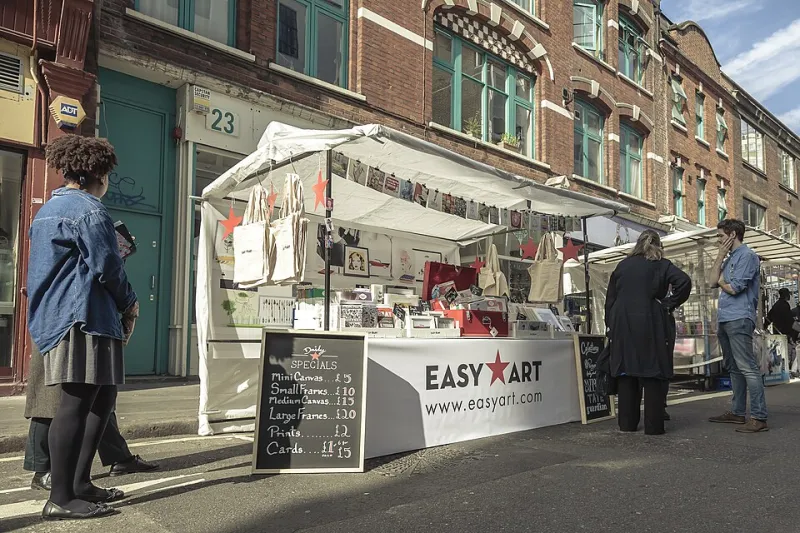
Photo: Stipple Scholar, CC BY-SA 4.0, via Wikimedia Commons
There's a moment, about twenty seconds into a first-ever stand-up set, when the audience works out that the person on stage has no idea what they're doing. It's not cruel, exactly. It's more like watching someone parallel park for the first time — you want them to succeed, but you're already wincing.
At The Free Trade in Ilford on a Tuesday night, that moment belongs to whoever drew the unlucky slot after the break. On the night we visit, it's a delivery driver named Kieran who has written three minutes of material about his satnav. Two jokes land. One dies so completely that the silence has texture. He shuffles off, orders a lager, and immediately starts rewriting in his notebook. He'll be back next week. They always come back.
The £3 Economy of Funny
London's comedy scene has a food chain, and the bottom of it is gloriously unglamorous. We're talking pub function rooms above Wetherspoons kitchens, the back of a Thai restaurant in Peckham, a community hall in Tooting with a crackling PA system. Entry is often free with a bucket going round, or a flat few quid — cheaper than the pint you'll inevitably buy to steady your nerves.
The economics are brutally simple. New comedians perform free (or actually pay for the privilege, in some legendary industry bar shows). The room makes money on drinks. The promoter — often a comedian themselves, doing it for the love and the email list — takes whatever's left. Nobody's getting rich. Everybody's getting reps.
And here's the thing the tourists never see: this is where the arena tours are incubated. Ask around at any big-name comedy show at the O2 and trace the CV backwards. Somewhere on it is a Tuesday in a basement in Angel, dying in front of a man playing Fruit Ninja on his phone.
The Compère Holds the Room Together
Every good open mic night has a resident compère, and every great one has a compère like Jo — a veteran of fifteen years who does twenty minutes of unpaid hosting because, in her words, "someone has to teach the audience how to behave."
She's a fixer, a firefighter and a fortune-teller all at once. She spots the stag do by the door and defuses it with a joke before it detonates. She coaxes energy out of a room that's three people short of empty. When a newcomer freezes mid-set, she's already moving towards the side of the stage with a well-timed heckle aimed at herself.
"The big gigs are TV with a live audience," she tells us between slots. "Down here, it's actual life. You can't edit. You can't walk out. You've just got to get the next laugh."
Where to Catch Tomorrow's Headliners Tonight
The beauty of the grassroots circuit is that your £4 is buying you a lottery ticket. That awkward act about their flatmate's sourdough starter? Give it eighteen months. So, for the curious:
- Angel Comedy at The Camden Head — free entry, seven nights a week, and genuinely the most reliable pipeline of new talent in the city. The Sunday new-material night is a rite of passage.
- The Comedy Café off Shoreditch High Street — a proper old-school room where you'll get a mix of seasoned pros trying out material and hungry newcomers.
- The Bill Murray in Clerkenwell — a dedicated comedy pub, which sounds niche until you realise it means the sound is good, the sightlines are good and nobody's trying to watch the football over your shoulder.
- Village pubs and community halls — from Highgate to Wimbledon, the suburbs run their own nights. Lower stakes, friendlier crowds, and first-timers who've told their whole office they're doing it and can't back out now.
How to Be a Good Audience (Yes, It's a Skill)
Sit somewhere you can see the stage. Don't heckle — the compère will handle it, and they'll be funnier than you. Laugh out loud or don't; the worst thing you can be is polite. And if you see someone bombing in a basement in Ilford, be kind. In a few years, you might be paying £35 to say you saw them first.