Gone by Friday: Why London Has Fallen for the Art of the Temporary
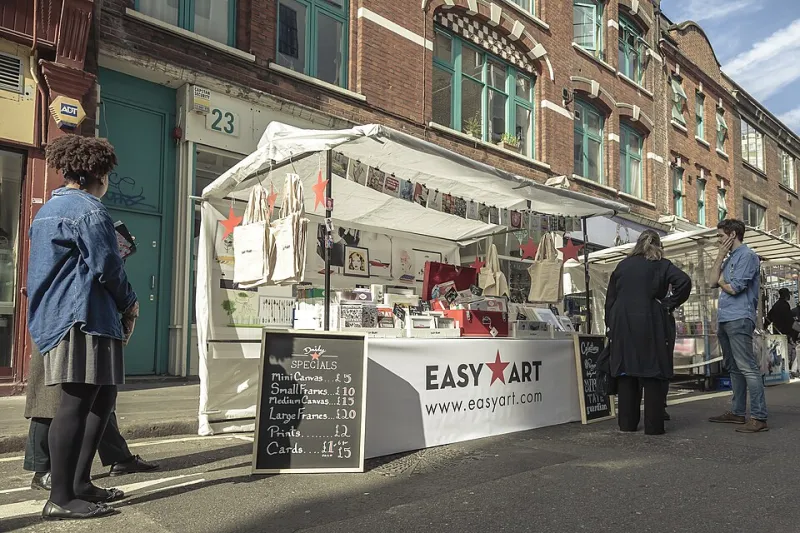
Photo: Davidmorgans, CC BY-SA 4.0, via Wikimedia Commons
Somewhere in Peckham right now, there is almost certainly a restaurant that didn't exist last month and won't exist next month. It might be serving Yemeni food in a space that was a tyre garage until recently. It might have a six-week waiting list. It will almost certainly have no sign outside and a reservations system that involves a Google Form and a degree of faith.
Welcome to London's pop-up economy — chaotic, creative, occasionally maddening, and absolutely everywhere.
The Economics of Impermanence
The rise of the pop-up wasn't inevitable. It was, in large part, a response to crisis. When business rates climbed and high street vacancies multiplied, landlords who'd once held out for blue-chip tenants began entertaining shorter-term arrangements. Meanwhile, a generation of entrepreneurs — chefs, designers, artists, retailers — found themselves with ideas and energy but not the capital for a traditional five-year lease.
The pop-up format solved several problems at once. For the operator, it meant low commitment and low risk. Test a concept, build a following, move on or scale up. For the landlord, it meant income from otherwise dead space. And for the customer, it created something that proved surprisingly powerful: scarcity.
There is something about knowing a thing won't last that makes people want it more urgently. A restaurant running for three weeks generates a buzz that the same restaurant running for three years simply cannot sustain. FOMO, it turns out, is a remarkably effective marketing strategy — and you don't even have to engineer it artificially when the concept is genuinely temporary.
From Brixton to Bermondsey: The Geography of Here Today, Gone Tomorrow
Pop-up culture isn't evenly distributed across London, but it's spread further than its east London origins might suggest. Brixton's railway arches and covered market have long hosted rotating food traders operating on informal arrangements. Maltby Street Market in Bermondsey — cramped, delicious, slightly difficult to find — began as a weekend overflow for traders who couldn't get pitches at Borough and evolved into something with its own fierce identity.
Dalston and Peckham remain reliable hotbeds. Both neighbourhoods have the combination of affordable (or formerly affordable) commercial space, high concentrations of creative workers, and a culture of experimentation that pop-ups require to thrive. Ridley Road Market in Dalston, one of the most genuinely diverse food markets in the city, has seen a new generation of traders set up alongside the long-established Caribbean and West African stalls — often running for a season, then pivoting.
More recently, the pop-up impulse has migrated to less expected corners. Walthamstow has developed a small but serious food and drink scene built substantially on temporary and semi-permanent concepts. Parts of Elephant & Castle, long in the shadow of its own regeneration story, have become incubators for exactly the kind of grassroots enterprise that pop-up economics enables.
The Supper Club Stays for Dinner
If there's one format that's come to define London's pop-up food scene, it's the supper club. The concept — a chef or cook hosting intimate, ticketed dinners in a non-restaurant space — has been around for years, but it's genuinely flourished in the post-pandemic period, when people were hungry (literally and figuratively) for communal eating experiences that felt human-scale and personal.
The best supper clubs have the feeling of being invited to someone's home who happens to be an extraordinary cook. Tables are communal. The menu is fixed. The conversation, by necessity, crosses the usual London boundaries of who talks to whom. Some of the most interesting ones have launched careers — chefs who built a following through monthly supper clubs before opening permanent sites, or who decided they preferred the freedom of the temporary format and never bothered with bricks and mortar at all.
There are now dedicated booking platforms for London supper clubs, which is either a sign of the format's maturity or the beginning of its inevitable commercialisation, depending on your outlook.
Retail's Restless Reinvention
It's not just food. London's pop-up retail scene has become a genuine alternative to the homogenised high street, and increasingly a deliberate lifestyle choice for shoppers who've grown bored of the same chains in every postcode.
Markets like Portobello, Spitalfields, and Columbia Road have always had a temporary, weekly quality to them — they exist as fully formed worlds for a few hours, then fold away. But the newer wave of pop-up retail is more curated and more concept-driven. Think independent bookshops appearing for a month in gallery spaces, or a capsule collection from a London designer sold exclusively from a converted van parked in Soho for a single weekend.
For independent brands with strong social media followings, the pop-up serves a function that a permanent shop can't: it creates an event. People don't just buy something; they attend something. They queue. They tell people about it. The physical retail experience becomes a piece of content in itself.
The Tension at the Heart of It All
There's a question worth sitting with, though. For all the energy and creativity of London's pop-up culture, it can also be a symptom of instability rather than a celebration of it. Not every chef who runs a supper club is doing so by choice — some would dearly love the security of a permanent site and simply can't afford one. Not every market trader is embracing impermanence as a philosophy; some are navigating genuine precarity.
The neighbourhoods that incubate pop-up culture — the Peckhams and Dalston of the city — are also the ones under the most pressure from gentrification. There's a circular irony in the fact that the creative energy generated by pop-ups often makes an area more desirable, which drives up rents, which makes the permanent version of those same concepts unviable.
London has always been a city that reinvents itself, sometimes brutally. The pop-up economy is just the latest expression of that restlessness — vital, a little precarious, and worth experiencing before it's gone.