Queue at Midnight: Why the Kebab Shop Is London's Last True Town Square
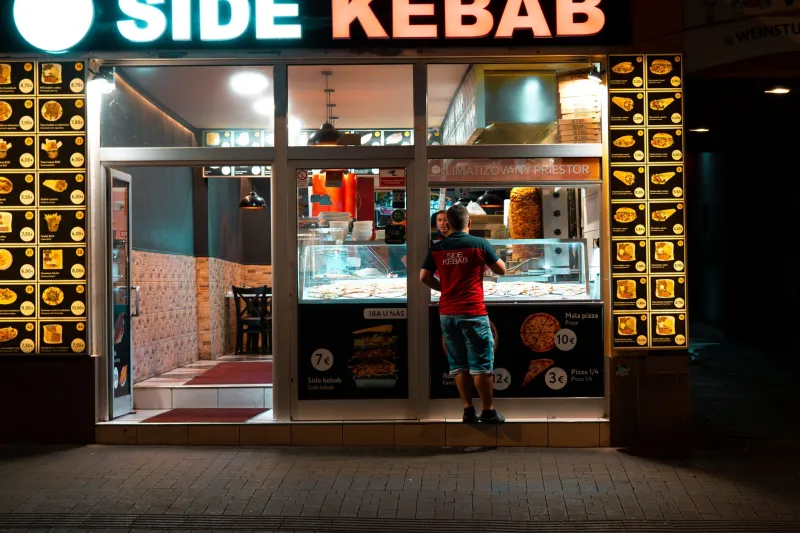
There's a moment — somewhere between the last tube and the first bird — when London stops pretending. The office banter has evaporated, the craft beer has done its work, and the city reveals what it actually is: thousands of hungry people looking for somewhere warm to stand. And for a remarkable number of them, that somewhere is a chicken shop with a flickering sign and a queue that runs out the door.
We've written before about London's secretive cocktail dens and the night bus as a moving observation deck. But the kebab house deserves better than a cameo. It deserves an argument. Here it is: the late-night kebab shop is the last genuinely democratic space in the capital, and we should treat it like the cultural institution it is.
Everyone in the Same Queue
Think about where else in London a nurse finishing a night shift, a delivery rider between orders, a group of students in fancy dress, a cabbie on his break, and a clubber in a sequinned top all stand shoulder to shoulder, waiting equally, for the same thing. Nowhere. Not on the Northern line, not at a gig, not even in a pub — pubs have their pecking orders, their regulars' corners, their unspoken rules.
The kebab queue doesn't care. The donkey jacket stands next to the designer coat. Nobody's buying a round for the room; everyone's buying their own chips. There's something almost radical in that, in a city where your postcode largely decides your pub, your gym and your coffee order.
The Spots That Hold the City Together
Every Londoner has their one. The place they defend with unreasonable passion.
In Peckham, there's the institution that's been flipping chicken since the late seventies, its walls layered with signed photos of boxers and rappers, its chilli sauce the subject of genuine local debate. Up in Dalston, the mixed grill at the all-nighter on Kingsland High Street has fed three generations of clubbers stumbling out of the same few warehouses. And in Soho, the tiny kebab shop wedged between two late bars has quietly become the finishing line of every good night out in W1 — you haven't really closed the evening until you've eaten something wrapped in foil on Old Compton Street.
These aren't just food stops. They're landmarks. Ask anyone who grew up in a London suburb about their local chicken shop and watch their face. It's where you went after school, after the match, after the funeral, after the wedding. It holds the neighbourhood's whole emotional calendar.
The Economics of Staying Open Late
Here's the uncomfortable part: these places are struggling. Rising rents, delivery app commissions, late-night licensing wrangles and the simple maths of staffing a till until 4am have closed plenty of beloved spots. When a kebab shop shuts, we don't get a heritage plaque or a mournful Guardian long-read. It just goes dark, and the queue disperses to the nearest chain.
And that would be a genuine loss — not just for late-night eating, but for night workers. The people keeping the city running between midnight and morning rely on these shops. Take them away and you take away one of the few reasons a paramedic's 3am feels survivable.
What Protection Would Actually Look Like
We're not suggesting Grade II listing for a fryer (though honestly, we'd sign that petition). But there are practical steps. Councils could factor in the cultural value of long-standing late-night food businesses when reviewing licensing and rent support. Campaigns like the ones that saved legendary music venues could extend to the shops that those venues' crowds spill into afterwards.
On an individual level, the prescription is simpler: go. Not just at 2am after the pub. Take the kids on a Tuesday. Get the mixed plate. Learn the owner's name. The best way to protect a democratic institution is to use it.
One Last Order
London is very good at monetising its own mythology — rooftop bars with views of the Shard, brunches that cost more than a railcard. But the city's soul has never lived at altitude. It lives at street level, under strip lighting, in the smell of onions and the sizzle of a vertical grill.
So next time you find yourself in that queue at midnight, look around. This is the whole city, in one room, waiting patiently for chips. Not many places can say that. Fewer still smell this good doing it.