Corner Shop Chronicles: The Independent Food Stores That Are the Real Soul of London
Photo: Crcjfly, CC BY-SA 3.0, via Wikimedia Commons
There's a moment, if you've ever stepped into the right kind of shop, where London stops feeling like a vast, indifferent city and starts feeling like somewhere that actually knows you exist. It might happen at a bakery counter where the owner remembers how you take your coffee. It might happen when someone pulls a jar of something from a shelf and explains, unprompted, exactly what to do with it. It might happen when you realise that the shop you're standing in has been run by the same family for forty-odd years, through recessions and redevelopments and a pandemic, and is still here.
London's independent food shops are not a niche interest. They're one of the most direct routes into understanding what this city actually is — a place built, district by district, by people who came from somewhere else and brought their food culture with them.
Golders Green: Where the Bread Still Means Something
If you want to understand the Jewish community's long relationship with north-west London, skip the history books and go to a bakery. Golders Green Road has changed considerably over the decades — the community itself has shifted and diversified — but the food culture remains stubbornly, beautifully intact.
Brent Street and the surrounding roads are still home to bakeries producing challah, rye loaves, and pastries according to recipes that predate the shops themselves. The owners will often tell you that the recipes came with the family from Eastern Europe, passed through two or three generations before landing in a north London kitchen. That continuity is remarkable when you think about it — flavours that survived displacement, war, and enormous social change, now available on a Saturday morning to anyone who makes the trip.
The shops themselves are social spaces as much as retail ones. Conversations happen at the counter that wouldn't happen anywhere else. Regulars are known by name, by preference, sometimes by family history. You don't get that from a self-checkout.
Green Lanes: A Street That Deserves Its Own Passport
Running through Haringey from Newington Green up to Palmers Green, Green Lanes is one of London's great underrated food streets. Its middle stretch, around Harringay and Turnpike Lane, is anchored by a dense concentration of Turkish and Kurdish supermarkets, bakeries, and grocers that make it feel — in the best possible way — like you've taken a wrong turn into Istanbul.
The supermarkets here are not small. Some of them are genuinely vast, stocking ingredients you'll struggle to find anywhere else in London: dried herbs by the kilo, multiple varieties of feta arranged in great brined slabs, fresh pastries that are made on the premises and gone by midday. The prices are often significantly lower than the equivalent in a mainstream supermarket, which is both a practical reason to visit and a reminder that these shops are serving communities, not catering to novelty.
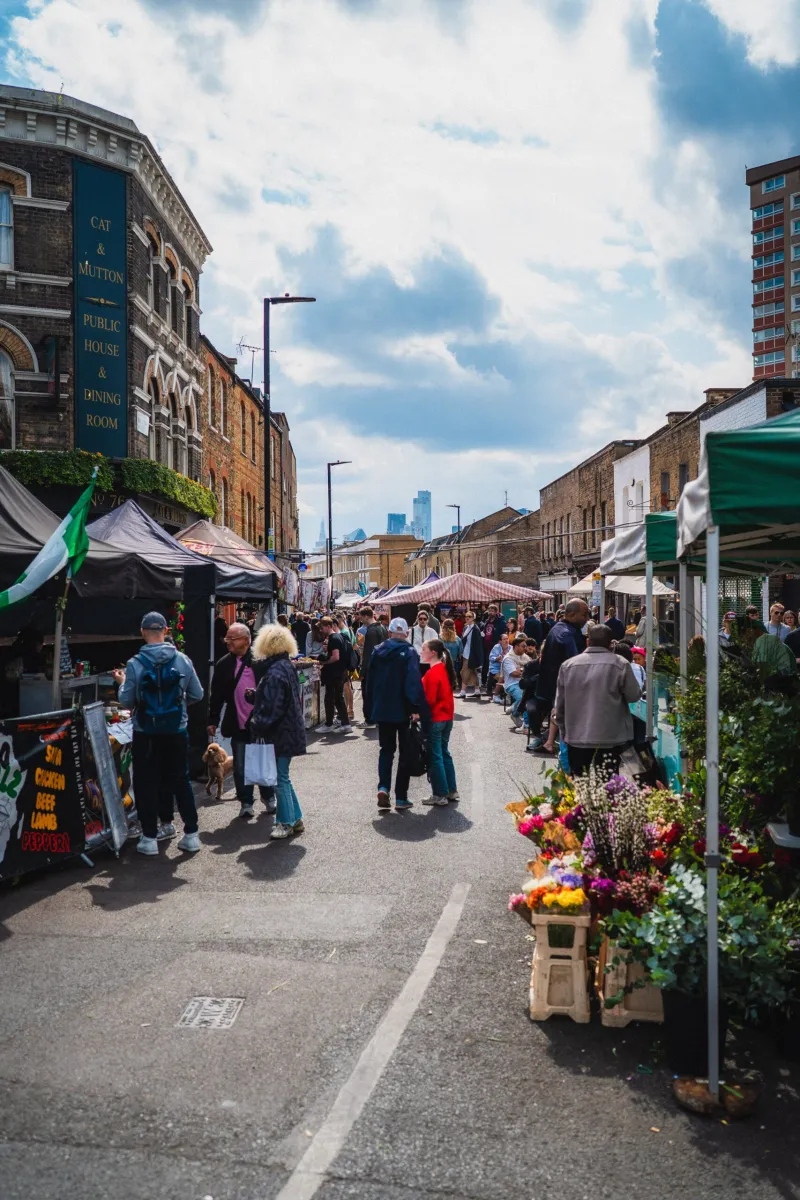
Spend an afternoon walking the full length of Green Lanes and you'll pass through several distinct food cultures in the space of a few miles. It's one of the most efficient ways to understand London's layered demographics — and you'll almost certainly go home with a bag of something you've never cooked before.
New Malden: Seoul Food, Surrey Postcode
New Malden is one of London's most quietly extraordinary places. Home to one of the largest Korean communities in Europe — and certainly the largest in the UK — it has a cluster of Korean supermarkets, restaurants, and food shops that are genuinely unlike anything else in the city.
The grocery shops here stock ingredients that Korean home cooks need and that you simply cannot find reliably elsewhere: gochujang in proper quantities, fresh perilla leaves, the specific varieties of noodles that matter for particular dishes. For the Korean families who live in and around New Malden, these shops are not a curiosity — they're a necessity. They make it possible to cook the food you grew up with, which is to say they make it possible to feel at home.
For the non-Korean visitor, they're an education. The staff are generally patient with questions, and the shops often stock English-language labelling or have handwritten notes explaining what things are. Go on a weekend morning when it's busy and you'll see the community in full swing — grandparents, parents, kids, all navigating the aisles together in a way that feels completely ordinary and, from the outside, rather wonderful.
Why These Shops Are Worth Fighting For
It would be easy to frame this as a nostalgia piece — a lament for a London that's being slowly homogenised. But that's not quite the right lens. The independent food shops that are thriving in 2024 are not relics. They're businesses that have adapted, that have survived against considerable odds, and that continue to offer something the chains structurally cannot.
What they offer is specificity. A Lidl or a Tesco serves a generalised customer with generalised needs. A family-run Polish deli in Hammersmith, or an Iranian grocery in Kensington, or a West African food shop in Peckham, serves a specific community with specific needs — and in doing so, it also serves anyone else who's curious enough to walk through the door.
The economic argument matters too. Money spent in an independent shop is far more likely to stay in the local area than money spent in a chain. The owner lives locally. They use local suppliers where they can. They employ people from the neighbourhood. The multiplier effect is real.
A Few Worth Seeking Out
Rather than an exhaustive list — which would be out of date the moment it was published — consider this a starting point. A. Gold on Brushfield Street in Spitalfields is a beautiful, idiosyncratic British deli that stocks regional produce from across the UK. Taj Stores on Brick Lane has been serving the Bangladeshi community and curious visitors since 1936. Lina Stores in Soho, now with a couple of offshoots, remains one of the finest Italian delis in London. And if you find yourself in Streatham, Persepolis — actually based in Peckham — is worth a dedicated trip for its Iranian pantry staples and the warmth of its owner, Sally Butcher, who has written several brilliant books about the food.
The real discovery, though, always comes from walking. Pick a neighbourhood you don't know well, find the high street that the estate agents haven't fully colonised yet, and pay attention to the shops that have been there for decades. They'll tell you more about where you are than any guidebook.
London's food shops are its memory. The ones that have survived are the ones worth knowing.