Platforms to Nowhere: The Ghost Stations and Lost Lines Hiding Beneath London's Streets
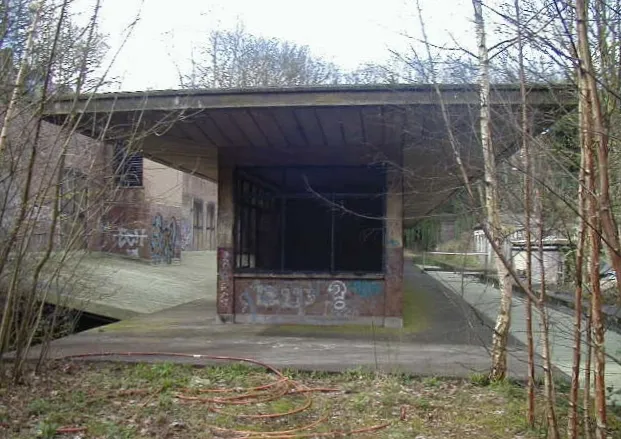
Photo: Hywel Williams, CC BY-SA 2.0, via Wikimedia Commons
Every Londoner has a complicated relationship with the Underground. You curse it when it's delayed, you defend it fiercely to anyone who dares compare it to the Paris Métro, and you navigate it with the kind of muscle memory that kicks in before you've even finished your morning coffee. But the Tube map you know — that elegant tangle of coloured lines Beck designed in 1933 — is, in a sense, a polished fiction. It shows you where you can go. It says nothing about where London almost went.
Beneath the streets, tucked behind bricked-up archways and down sealed staircases, is a ghost network. Stations that opened and closed. Lines that were approved, partially built, then abandoned when the money ran out or the politics shifted. Extensions that would have transformed entire neighbourhoods, had history bent even slightly differently. This is London's parallel underground — and it's every bit as revealing about the city as the one that actually runs.
The Stations That Time Forgot
Start with the one most Londoners walk past without a second glance. Aldwych station, tucked off the Strand, closed permanently in 1994 after decades of on-off service. Its terracotta façade is still intact, its signage unmistakably period, and it's become a favourite location for film crews wanting that authentic Blitz-era atmosphere. You may have seen it in Atonement or V for Vendetta without realising it. Step back from it on a quiet weekday morning and it's genuinely eerie — a fully formed station, frozen.
Then there's Brompton Road, between Knightsbridge and South Kensington on the Piccadilly line. Closed to passengers in 1934, it was quietly requisitioned by the military during the Second World War and used as an anti-aircraft command centre. The lift shafts, the deep-level tunnels — all repurposed for the war effort. Today the surface building has been converted into private flats, and unless you know what to look for, you'd stroll past it without a flicker of recognition.
Brook Street in the East End, Mark Lane near Tower Hill, City Road off Old Street — the list of departed stations is longer than most people realise, each one a small archaeological site of the city's evolving priorities.
The Lines That Almost Were
Abandoned stations are one thing. Cancelled lines are something else entirely — they speak to ambition, to the city's perpetual struggle between vision and practicality, between what London wants to be and what it can actually afford.
The most tantalising ghost on the map is probably the Northern line extension that was supposed to reach Alexandra Palace. Planning began in the 1930s, tunnelling actually started, and then the war intervened. When peace came, the money didn't follow, and the project was shelved. To this day, partially excavated tunnels exist beneath north London — dark, damp, and completely purposeless. Finsbury Park and beyond might have looked very different had those trains ever run.
The Fleet line — later rebranded and partially realised as the Jubilee line — was originally drawn up to cut through south-east London, linking Lewisham and Fenchurch Street into a coherent east-west corridor. What we got instead was a truncated version that didn't push east of Charing Cross until the late 1990s. The Jubilee line extension to Stratford, which finally opened in 1999, transformed places like Canary Wharf and Bermondsey almost overnight. Imagine what three more decades of that connectivity might have done for Greenwich or Deptford.
What the Architecture Tells You
One of the pleasures of knowing this history is that it changes how you look at the city above ground. London's surface is littered with clues.
Leslie Green's ox-blood red terracotta station buildings — the ones he designed in bulk for the early 20th century Underground — crop up in unexpected places, some repurposed as shops or restaurants, their original function barely legible. The distinctive curved facades, the tall arched windows: once you start noticing them, you can't stop.
Walk along certain stretches of the District or Metropolitan lines out in the suburbs and you'll spot the ghost platforms — wider than they need to be, or cut off at strange angles — evidence of junctions that were planned and never built. In Ealing, in Uxbridge, in the outer reaches of the network, the infrastructure sometimes hints at futures that were drawn up in boardrooms and then quietly abandoned.
What It All Means for the City
There's a temptation to read London's abandoned transport history as pure tragedy — all that potential, wasted. But there's another way to look at it. The gaps in the network shaped the city just as powerfully as the lines that were built.
Because the Tube never properly reached south-east London, that part of the city developed differently — denser bus networks, more self-contained high streets, a slightly different relationship with the centre. Brixton, Lewisham, Peckham: they grew their own identities partly because they weren't as easily absorbed into the commuter logic that the Underground tends to impose. Whether that's a good or bad thing probably depends on who you ask.
And the story isn't finished. Crossrail — now the Elizabeth line — spent decades as a plan before it became a reality. The Bakerloo line extension to Lewisham is still being argued over. There will, almost certainly, be future historians writing about the schemes we're debating right now that never came to pass.
How to See It For Yourself
If this has piqued your curiosity, you're in luck. The London Transport Museum runs regular Hidden London tours of disused stations — Aldwych, Down Street (used by Churchill's War Cabinet), and others. They book out fast, so get on the mailing list rather than leaving it to chance.
For the armchair explorer, the Museum's main site in Covent Garden has a genuinely excellent archive and rotating exhibitions. And if you just want to start noticing things on your commute, download a map of disused stations and cross-reference it with your regular route. You'll be surprised how many ghosts you pass every day without knowing it.
London is always several cities at once — the one you can see, the one being built, and the one that was planned and never arrived. The Underground's abandoned history is one of the best windows into all three.