Warm Air and Gossip: A Day Inside the Laundrettes That Still Hold London Together
The 7am Duvet Run
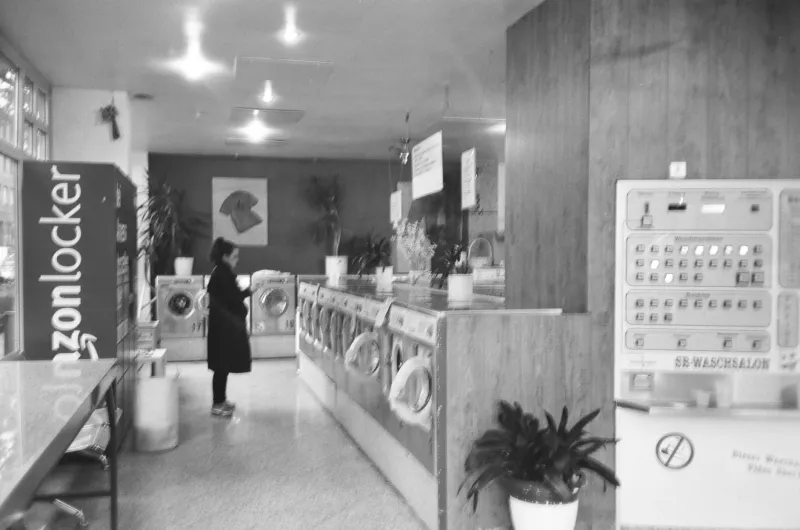
The shutters go up on Launderama on Bethnal Green Road at seven, and by half past there's already someone feeding a king-sized duvet into an industrial drum like a man wrestling an eel into a sleeping bag. Nobody owns a washing machine big enough for a duvet. That's the practical reason launderettes survive. But stick around for an hour and you'll realise the duvets are just the cover story.
What actually happens in here is something closer to radio. Local radio, with the volume turned down low and the presenters unaware they're broadcasting.
"Did you hear about the chippie? Sold up, apparently." A woman in a dressing gown announces this to the room at large, shaking a bag of whites. Nobody asks who told her. The launderette is where such intelligence is verified, contested and filed.
Machine Six Is a Philosopher
There's a handwritten sign taped to machine six — the one that eats 20ps and sometimes gives up mid-spin. It reads: Patience. It always comes round again. Nobody knows who wrote it. Everyone quotes it.
That's the thing about these places. The notices on the walls do a kind of accidental philosophy: Please remove your lint. Your mother doesn't work here. Times are hard for everyone, including the tumble dryer. In an era of sanitised gym chains and identikit coffee shops, the launderette remains one of the last rooms in London where the décor is entirely democratic — which is to say, nobody's in charge of it.
The regulars have their spots, their machines, their times of day. The woman who does a week's wash every Tuesday morning and reads the free papers cover to cover. The man who comes in with one shirt, alone, which everyone privately understands to be about something other than laundry.
Brixton, Same Story, Different Fabric Softener
Over in Brixton, a 24-hour self-service place off Railton Road keeps its fluorescent lights burning all night like a lighthouse for the sleepless. Night workers come here. Insomniacs. People who've had a row and need somewhere warm and neutral to sit for ninety minutes while a machine makes decisions for them.
"You get everything in here at three in the morning," the woman behind the counter tells me, not looking up from her phone. "Wedding dresses. Football kits after a loss. One bloke washed everything he owned because he said he was starting again." She shrugs. "Starting again starts somewhere. Might as well be here."
There's a particular kind of equality in a launderette that's hard to find elsewhere in the capital. The person waiting on the plastic chairs next to you might be a landlord, a nurse, a student, or all three depending on the day. The machines don't care. The timer doesn't care. Everyone's socks go in together, in spirit at least.
Why We Keep Coming Back
The obvious question: with a machine in every kitchen, why does any of this still exist? The answer, it turns out, is layered like a load that's been left in the drum too long.
Yes, the duvets. Yes, the big items. Yes, the flat-shares of Zone 2 where the "washing machine" is a mythical beast mentioned in the listing but never witnessed. But mostly it's the thing no app has managed to replicate: low-stakes, unforced company. You can't rush a wash. You're a captive of the cycle, and so is everyone else, and that shared captivity does something that no co-working space with its £4 flat whites has ever achieved.
There's even a quiet romance to it. At least two long marriages in south-east London, I'm told, began with a borrowed box of Persil and a broken machine number nine.
How to Do the Laundrette Properly
A quick word for the uninitiated, because there is an etiquette and it is enforced by the room:
- Never leave your load in the machine past the spin. The regulars will eye it. Someone will eventually move it, with commentary.
- Bring your own powder if you can. The vending machine sachets are a tax on the forgetful.
- If someone asks how your week's going, the correct answer is three minutes long, not three seconds. You've got a whole cycle. Use it.
The Last Warm Rooms
They're closing, of course, slowly — rents and rewires and the slow disappearance of the laundrette's natural habitat, the small flat with the big family. But enough of them hang on, and they hang on because they're not really about laundry at all. They're warm rooms with chairs, where the news travels by mouth and the machines, like the neighbourhood, always come round again.
Go once for the duvet. Stay for the rest of it.