Beauty in the Barriers: How London's Building Sites Became the City's Most Honest Art Galleries
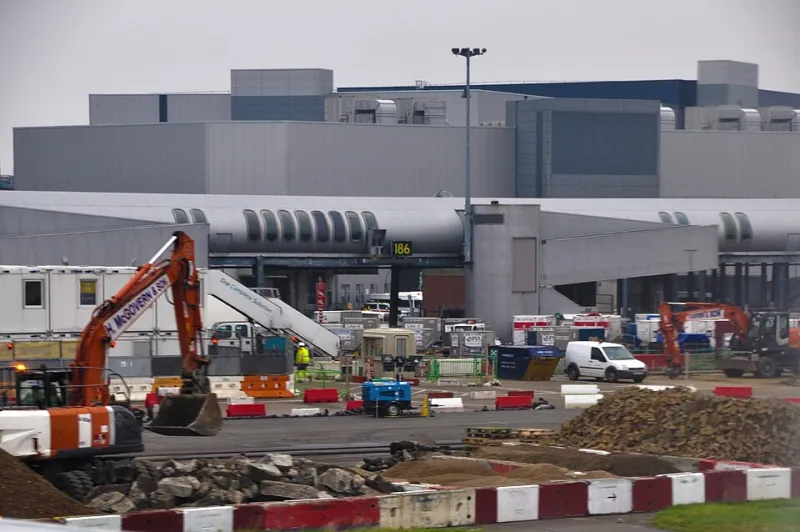
Photo: Lewis Clarke , CC BY-SA 2.0, via Wikimedia Commons
London is always mid-sentence. Walk any direction from any postcode and you'll eventually hit a wall of blue hoarding, a tower crane pivoting overhead, or a pavement diversion that adds ten minutes to a journey you've done a hundred times. The city is, and probably always has been, a work in progress. But somewhere between the planning applications and the concrete pours, something interesting started happening. People began paying attention.
Not just architects and developers. Photographers, artists, historians, and plain old curious Londoners started treating construction sites as destinations — places worth visiting precisely because they won't exist in this form for long. The temporary, it turns out, has real pull.
The Hoarding as Canvas
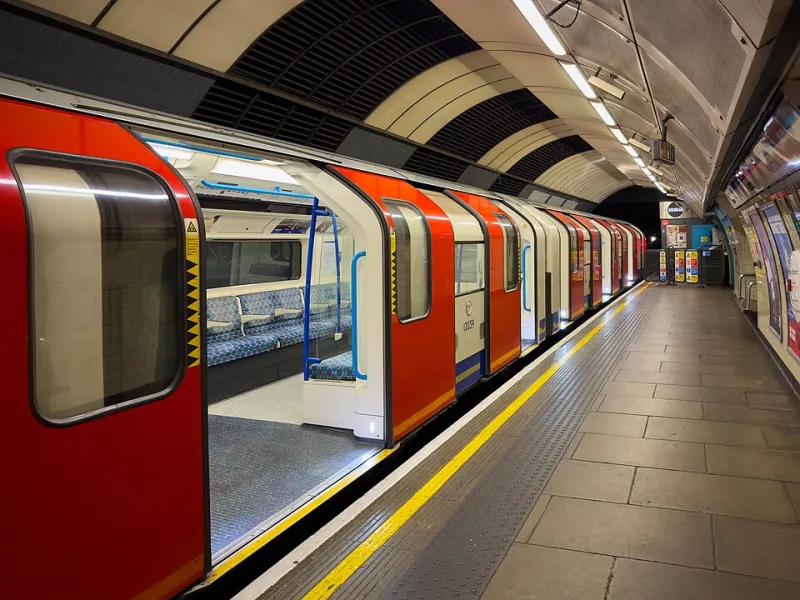
It started, in a visible way, with the Elizabeth line. When Crossrail's construction consumed great swathes of central London — Oxford Street, Farringdon, Whitechapel — the hoardings that sealed off the chaos weren't just safety barriers. They became something closer to a public exhibition. Commissioned artwork, photographic timelines, architectural renderings of what lay beneath: for years, Londoners walked past daily updates on one of the most complex engineering projects the country had ever attempted.
The stations that eventually emerged — Paddington with its swooping white ribs, Canary Wharf's cavernous box sunk into the dock, Bond Street's cool, column-free vastness — felt less like transport infrastructure and more like civic sculpture. Architect after architect cited them as a genuine step forward for public space design. But the journey mattered too. The hoardings weren't just a screen hiding the mess. They were, for many, the first chapter of a story they were watching in real time.
That approach has influenced how developers across the city now think about the interface between building sites and the public. The question is no longer just 'how do we keep people away from the construction?' It's 'what do people see while they're waiting?'
Riverside as Laboratory
Head down to the South Bank stretch between Vauxhall and Nine Elms and you're walking through one of the most dramatic urban transformations London has seen in decades. The old power station — once a ruin, now a neighbourhood anchor — sits at the centre of a development zone that has been reshaping itself for the better part of fifteen years.
Battersea Power Station's hoardings, at their peak, covered entire city blocks. And rather than treat that as dead space, the project leaned in. Pop-up events, temporary markets, photography exhibitions mounted on the barriers themselves. The construction site became a reason to visit before there was anything finished to visit. That's a genuinely clever trick, and it's one that the Nine Elms development — with its embassies, its sky gardens, its half-built towers still finding their legs — has continued to pull off with varying degrees of success.
Walk along the riverfront on a clear morning and the unfinished skyline reads almost like a deliberate composition: cranes in silhouette, glass towers half-clad, scaffolding catching the light in ways that finished buildings rarely do. It's chaotic and it's beautiful, and the photographers who turn up at dawn clearly agree.
Scaffolding Tourism Is a Real Thing
It sounds slightly absurd, but there's a growing community of Londoners — and visitors — who actively seek out buildings mid-restoration. The ongoing work on the Palace of Westminster, scheduled to run for years yet, has already attracted its own quiet audience. The scaffolding that periodically envelops St Pancras, or wraps around the facade of a Wren church in the City, creates a completely different relationship between building and viewer.
You notice details you'd otherwise walk straight past. The carved stonework of a Victorian facade is suddenly at eye level. A medieval window frame sits behind a grid of steel poles in a composition that no architect ever planned but that somehow works. Instagram has amplified this, of course — there are entire accounts dedicated to London scaffolding and construction photography — but the impulse predates social media. People have always been drawn to things in transition.
The Museum of London Archaeology (MOLA) has tapped into this instinct for years, offering glimpses of what gets uncovered when London digs down. Every major construction project in this city is also an archaeological dig. Roman walls, medieval foundations, plague pits, Victorian infrastructure: it all comes up eventually, and when it does, the building site briefly becomes something else entirely.
Where to Look Right Now
If you want to experience London's construction culture at its most vivid, a few spots are worth your time at the moment.
The City of London's eastern fringes — around Liverpool Street and Bishopsgate — are in the middle of another wave of tower building, and the contrast between the Victorian railway architecture and the glass-and-steel frames going up around it is genuinely striking. Stand on Bishopsgate on a weekday morning and you're watching three or four different centuries of London existing simultaneously.
Over in Elephant and Castle, the regeneration that's been grinding forward for years has reached a stage where the new and the demolished sit side by side in ways that feel almost theatrical. The old shopping centre is gone; its replacement is rising. The neighbourhood around it is recalibrating. It's uncomfortable in places, but it's also completely honest about what cities actually do.
And if you want something more curated, the ongoing work around London Bridge and Borough — where new office and residential development keeps bumping up against one of the city's oldest markets — offers a compressed version of the whole London story: ancient, modern, and perpetually unresolved.
The Patience of the Long Game
There's something Londoners understand about their city that visitors sometimes miss: the finished version is never really the point. London's character lives in the friction between what it was and what it's trying to become. The construction sites, the scaffolding, the hoardings covered in architectural promises — they're not obstacles to the real London. They are the real London.
The best of these spaces acknowledge that. They don't apologise for the disruption. They invite you to watch, to photograph, to wonder. They treat the person walking past not as an inconvenience to be managed but as an audience for something genuinely worth seeing.
Not every development gets it right. Plenty of hoarding is just hoarding, and plenty of construction is just construction. But when a building site earns your attention — when it makes you stop, look up, and feel something about the city you're standing in — that's not an accident. That's London doing what it's always done: building itself in public, one temporary spectacle at a time.