Pawns in the Park: The Outdoor Chess Tables Where London Slows Down
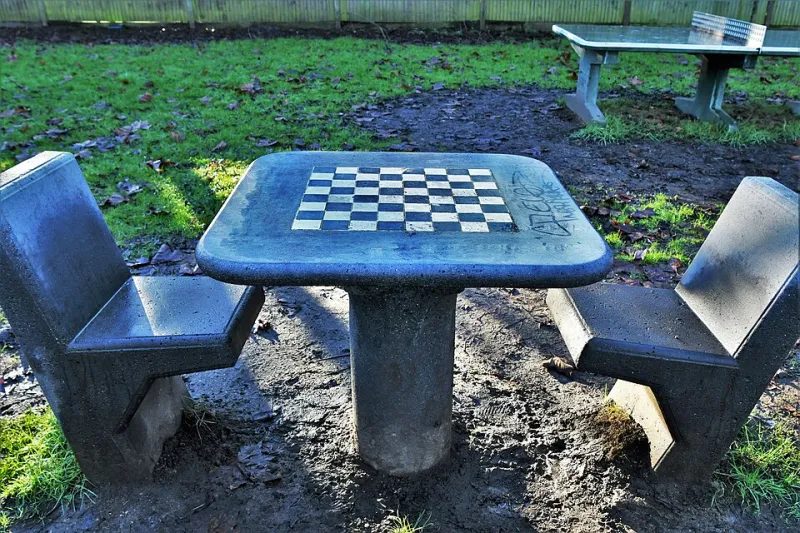
Photo: Michael Garlick , CC BY-SA 2.0, via Wikimedia Commons
A Saturday morning in a Bloomsbury square, 2026. The tables are damp from the night, and a man in a flat cap is already setting out the pieces. He does not know who will turn up. He does not need to. By ten past nine, a schoolkid has taken the opposite seat, and the game has begun.
The board does the introductions
Outdoor chess in London is not a spectator sport. It is a quiet, improvised social club with no membership list and no committee. The tables are usually simple: a fixed board, a couple of benches, maybe a bin nearby. The pieces are often chipped. The etiquette is unwritten. You sit down, you ask if they are waiting for someone, and then you play.
The man in the flat cap is a retired bus driver. He has been coming to this square for years. He says the board does the introductions for him. 'You don't have to talk about the weather,' he says. 'You just move a piece. After that, you've got something to say.'
A game with no membership fee
Most of the players are not serious. They know the rules, they know a few openings, and they know that losing is part of the deal. A few are very good, and they will beat you without making a fuss about it. The best players are usually the ones who explain what you did wrong after they have done it.
There are retired locals, schoolkids on half-term, newcomers who have just moved to the area, and people who work nearby and have an hour to kill. The games are short. The conversations are longer. Nobody is playing for prizes. They are playing for pride, for company, and for the pleasure of doing something that requires attention.
Estate courtyards and park corners
The tables are scattered across London in places you might not expect. A corner of a park in Peckham. An estate courtyard in Bethnal Green. A square in Bloomsbury where the tourists walk past without noticing. Some are official. Some have been installed by councils or community groups. Some are just a board screwed to a table that someone has claimed as their own.
In 2026, these tables are often full. That is not an accident. They are free, they are outdoors, and they do not require you to spend money. In a city where so much social life is tied to buying something, that matters. You can sit at a chess table for an hour and spend nothing at all.
Why it works in a city in a hurry
London is a city that likes to be busy. We queue, we rush, we check our phones. The chess table interrupts that. It asks you to sit still and think about one thing at a time. It is not a wellness trend. It is just a board with sixty-four squares and a person on the other side of it.
That is why the tables work. They create a rare, unplanned social space. You do not have to book. You do not have to be good. You do not have to stay. But if you sit down, you might find yourself talking to someone you would never otherwise meet.
By lunchtime, the square is busier. The flat-cap man has won two games and lost one. The schoolkid has learned a new trap. The pieces are packed away, and the table is empty again. Tomorrow, someone else will sit down. The board will be waiting.